

On 15 September 2026, Kyiv hosted the XI Business & Legal Energy Forum, organized by the Yurydychna Praktyka publishing house. ESQUIRES supported the forum as its Professional Partner. Managing Partner Oleksandr Shkelebey moderated the closing session, “Investing in New Energy”, and Partner Viktoria Kovalchuk presented an analysis of case law on force majeure and war risks in energy contracts.
The forum brought together representatives of the public sector, the transmission system operator, international partners, business and the legal community. The discussion centred on two questions that will shape the future of Ukraine’s energy sector: how to attract private capital into new generation, and how to protect energy contracts in wartime.
SESSION 3. INVESTING IN NEW ENERGY
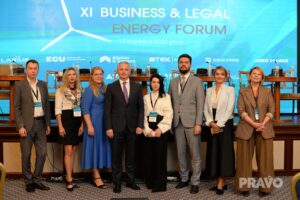
What does it take to bring private capital into Ukraine’s new energy sector? This question set the agenda for the forum’s closing session, moderated by ESQUIRES Managing Partner Oleksandr Shkelebey.
Opening the discussion, the moderator presented the results of a poll conducted during the forum’s first session: 70% of participants favoured the development of distributed generation, while 30% supported a centralized model. Participants named weak investor guarantees, grid connection problems and insufficient financing as the key barriers to new generation. Oleksandr Shkelebey stressed that Ukraine needs distributed generation, energy storage and new market instruments, and that domestic and international investors alike need clear, stable regulation and effective de-risking mechanisms.
Speakers:
— Roman Shakhmatenko, Head of Energy and Environment Portfolio, UNDP in Ukraine;
— Olha Kulyk, Head of Carbon Regulation Programmes Unit, JSC Decarbonization Fund of Ukraine;
— Kateryna Danylkova, Deputy Director for Prospective Projects, SE Guaranteed Buyer;
— Olha Sydorchuk, Partner, Head of Construction Practice, Altelaw & Sempra;
— Kateryna Krasnova, Executive Director, JSC Energy Company of Ukraine;
— Olena Koltyk, Head of Energy Sector, BRDO; Founder, Ukraine Support Team;
— Oleksandr Vizir, Energy and Climate Sector Coordinator, Ukraine Facility Platform;
— Oleksandr Martyniuk, Head of Strategic Planning and Analytics Department, NPC Ukrenergo.
Projects, not just money
Roman Shakhmatenko described UNDP’s work to prepare Ukraine’s energy sector for winter and modernize urban energy infrastructure, including in Kyiv, Mykolaiv and Zaporizhzhia. In his view, the challenge lies not only in access to funds but also in the capacity of communities and municipal utilities to build a solid pipeline of projects that can be financed with attracted resources. Other challenges include frequent regulatory changes, a large number of supervisory bodies, staff shortages and the need to retain engineering teams. Grant and budget funding alone cannot improve the investment climate: what is needed is sustained work on community capacity, diversified funding sources and lower risks for investors.
State financing: the Decarbonization Fund of Ukraine
Olha Kulyk presented JSC Decarbonization Fund of Ukraine, a financial company wholly owned by the state through the State Agency on Energy Efficiency and Energy Saving. The Fund provides loans and financial leasing of up to UAH 90 million at 5–9% per annum, as well as factoring. Eligible borrowers include companies, state and municipal enterprises, local self-government bodies, sole proprietors, homeowners’ associations and cooperatives that have operated in Ukraine for at least one year. The Fund supports projects in industrial and building energy efficiency, renewable generation with or without storage, high-efficiency cogeneration, alternative fuels, electric transport and energy storage. In 2024–2026, it financed 92 contracts worth over UAH 2.3 billion, with a total project value exceeding UAH 3 billion. The expected annual impact is a reduction of 168,000 MWh in energy consumption and nearly 27,000 tonnes of CO₂ emissions.
Green auctions and the market premium
Kateryna Danylkova spoke about the development of the auction-based support scheme for renewable electricity producers. The state support quota for 2026 is 1,000 MW. To make auctions more attractive to investors, the scheme has moved to a market premium model, the required financial security has been reduced, and it can now be provided as a bank guarantee or as funds deposited in an escrow account. Upcoming auctions will allocate quotas for solar plants, energy storage systems and other generation facilities.
Permitting: Cabinet of Ministers Resolution No. 1320
Olha Sydorchuk analysed permitting procedures for energy storage facilities. For the period of martial law, Cabinet of Ministers Resolution No. 1320 of 7 December 2023 allows gas cogeneration units, energy storage systems and power lines to be installed without zoning conditions, design review, a construction permit or prior land allocation, and construction may proceed in parallel with design. However, the Resolution does not waive requirements for design documentation, building codes or safety standards. Within 24 months after construction is completed, and no later than six months after martial law ends, the developer must allocate and form the land plot, register property rights, approve the design, obtain a design review report and secure a certificate of acceptance into operation. The Resolution should therefore be seen as a temporary deferral of permitting procedures rather than their cancellation. Key risks include the inability to legalize a facility if land restrictions emerge, non-compliance with building codes, and tight deadlines. She also noted that energy storage facilities may be located on land of any category, but this rule does not apply to solar power plants.
The economics of aggregation: from installed megawatt to working asset
Kateryna Krasnova showed that, with identical equipment, market access determines financial performance. According to historical data from ECU’s aggregated group, a 1 MW gas cogeneration unit operating independently on the day-ahead market alone generated UAH 17.2 million per year. As part of the aggregated group, with access to the day-ahead, intraday and balancing markets, it generated UAH 27.1 million, or 57% more. For a 1 MW solar plant with 4 MWh of storage, gross revenue rose from UAH 18.9 million to UAH 22.8 million per year (+21%). It is the storage unit that gives such an asset access to the balancing market, where a solar plant alone cannot operate.
Energy communities and local resilience
Olena Koltyk highlighted the European trend towards energy communities, in which local authorities, municipal utilities, businesses and residents jointly generate, consume and share energy. For Ukraine, this is an opportunity to strengthen community resilience, cut energy costs and keep capital in the region. At the same time, the centralized system is currently cheaper for consumers, partly because the market is not yet fully regulated. The number of installed megawatts alone does not guarantee resilience, so community plans must reflect the real needs of critical infrastructure and blackout scenarios of varying duration. The goal is a new planning architecture in which every project has an economic rationale and a document package sufficient for an investor to come in.
From community ambitions to investment portfolios
Oleksandr Vizir presented the Ukraine Facility Platform methodology, already applied in seven communities. It covers an energy audit, the selection of technology configurations for each grid connection point with cost and payback assessment, legal and organizational structuring, and the aggregation of individual projects into a coherent portfolio. A legal roadmap for 20 energy facilities has been developed for two communities. In his view, donated equipment breeds inefficiency, and grant-funded equipment should go primarily to social facilities such as schools and kindergartens.
System needs and new Ukrenergo auctions
Oleksandr Martyniuk said that, according to Ukrenergo’s forecast, Ukraine will need 1.5 GW of new flexible generation and 0.9 GW of energy storage by 2030, along with substantial new renewable capacity. This capacity should complement, not replace, existing generation. Over the past eighteen months, the average electricity price in Ukraine was 22% higher than in neighbouring countries, yet price signals alone may not be enough for investors. Available mechanisms include green auctions and ancillary services auctions, of which Ukrenergo has already held four rounds. He also presented a new auction mechanism for building flexible distributed generation based on a market premium, paid during peak demand hours: seven hours a day in winter and five in summer.
“Ukraine’s energy resilience is built by those who are ready to invest, build distributed capacity and take on risk now, without waiting for perfect market conditions,” Oleksandr Shkelebey concluded.
Session recording (in Ukrainian): https://youtu.be/zGLcUn-miH0
SESSION 2. FORCE MAJEURE, WAR RISKS AND THE PERFORMANCE OF ENERGY CONTRACTS
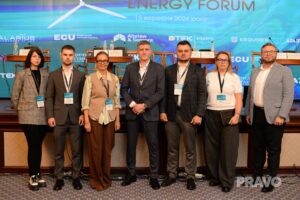
The forum’s second session focused on litigation and arbitration and was moderated by Oleksandra Fedotova, Partner at ADER HABER. ESQUIRES Partner Viktoria Kovalchuk, attorney-at-law and mediator, delivered a presentation titled “Force Majeure, War Risks and the Performance of Energy Contracts: Current Case Law”.
Over the years of war, businesses have lost the illusion of a “war shield”: war alone releases no one from liability or from performance. Courts examine how a specific wartime event affected a specific obligation and answer three questions: does the event release a party from liability, does it terminate the obligation itself, and does it give grounds to amend or terminate the contract?
A certificate is not a free pass
The general letter of the Ukrainian Chamber of Commerce and Industry of 28 February 2022 does not prove force majeure for any specific obligation. Even an individual force majeure certificate is not binding on the court: it is assessed critically and together with other evidence.
Three tools the courts clearly distinguish
— Force majeure (Article 617 of the Civil Code of Ukraine) releases a party from penalties, but not from the obligation itself or from 3% annual interest and inflation losses under Article 625, which compensate for the depreciation of money rather than punish.
— Termination of an obligation due to impossibility (Article 607) requires objective impossibility of performing that specific obligation. A missile strike on tanks holding stored fuel ends the duty to return that fuel, but the destruction of production assets does not end the duty to pay for electricity or gas already delivered.
— Material change of circumstances (Article 652). If performance remains possible but has become loss-making due to tariff revisions or a collapse in day-ahead market prices, this is not force majeure. The appropriate remedy is to seek amendment or termination of the contract, proving all four conditions of Article 652.
Electricity
A lack of funds, even when caused by non-payment by households or the Guaranteed Buyer, is a business risk. At the same time, NEURC Resolution No. 332 suspended the accrual and collection of penalties between electricity market participants, and the Supreme Court held this rule to be mandatory, so there is no need to prove force majeure in such disputes (Case No. 911/1359/22).
Gas and heat
Loss of control over facilities in occupied territory may be one of the grounds for dismissing a claim (Case No. 913/264/23). However, a destroyed boiler house is force majeure for heat supply, not for a debt for gas already consumed. Critical infrastructure status does not release a company from its monetary obligations.
“Wave” force majeure
A plant under shelling and blackouts repeatedly shut down, resumed operations and shipped products in part. Was performance continuously impossible? A panel of the Commercial Cassation Court of the Supreme Court takes the view that it was not: impossibility must be proven for specific hours and days, allowing reasonable time to restart production. Case No. 904/2344/24 (Ukrgasvydobuvannya v. Interpipe Niko Tube) has been referred to the Grand Chamber of the Supreme Court, whose final position is still pending.
Five practical rules for energy companies
1. Tailor your force majeure clause to the risks of your segment instead of copying a template.
2. Set out the procedure, deadlines and consequences of notifying the counterparty, and follow them strictly.
3. Remember that financial difficulties do not cancel the duty to pay.
4. Collect technical evidence: damage reports, dispatch orders, operational logs and State Emergency Service records, not just a Chamber of Commerce certificate.
5. Document all steps taken to preserve assets and mitigate losses.
“The winner isn’t the party holding a Chamber of Commerce certificate. It’s the party with a properly structured contract,” Viktoria Kovalchuk concluded.
Presentation recording (in Ukrainian): https://youtu.be/SevjEtNhriU
Read more about the forum discussions in Yurydychna Praktyka’s coverage (in Ukrainian)
We thank Yurydychna Praktyka for organizing the forum, and the speakers and colleagues for an open and expert dialogue.